Speed keeps players happy, but regulators judge you on proof. Under the Gambling Commission’s remote customer interaction guidance, Requirement 13 asks licensees to evaluate whether their overall approach to customer interaction works, and to be able to show the Commission the outcomes.
Customer-support quality assurance clears that bar. For every chat, ticket, or bot reply it asks: Did we solve the problem, follow every rule, and leave an auditable trail?
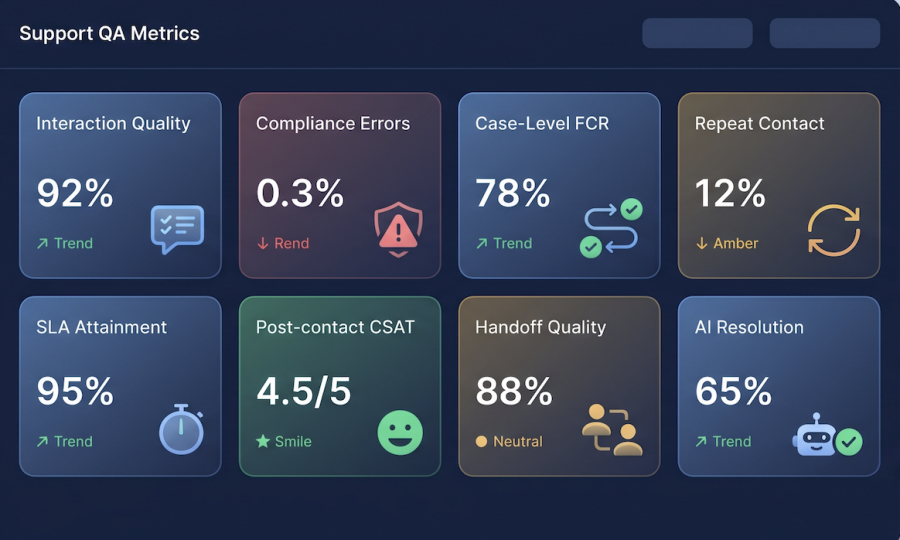
Below are eight customer-support QA metrics every iGaming operator must track, complete with formulas, real-world risk scenarios, and safeguards that keep each number honest.
The eight metrics at a glance
First, here’s the whole scorecard on one page. Each metric answers a different quality-assurance question and surfaces a specific risk, from routine password resets to a frozen-withdrawal dispute.
Keep this cheat sheet handy as we break down each metric in depth, starting with the engine of any support QA program: Interaction Quality Score.
1. Interaction quality score
Quality begins with accuracy. Before we judge speed or satisfaction, we need one percentage that proves a chat, email, or bot reply was handled correctly, completely, and in the right tone.
We build that number from a weighted scorecard. Each conversation earns points for the essentials: understanding the player’s request, giving accurate information, completing any required verification, using clear language, documenting the outcome, and escalating when the stakes rise. Add empathy and professionalism, and you have full coverage.
Formula:
Interaction Quality Score = Points earned ÷ Points possible × 100
Keep the score meaningful with a critical-fail override. If an agent or bot reveals account data without verification, promotes a bonus during a responsible-gambling intervention, or misguides a KYC check, the interaction scores zero, even if the greeting was perfect. Tools can apply a rubric like this at scale. Comm100’s AI Quality Assurance, for example, scores chats against the operator’s own rubric, including responsible-gambling criteria, explains every score, and turns a result into a coaching item with one click; the operator decides how much gets reviewed.
The stakes are real. In January 2024 the Gambling Commission imposed a £6 million penalty on Gamesys for social-responsibility and anti-money-laundering failures, including limited interactions with at-risk customers and poor records of those interactions.
Two habits keep the metric honest:
Weekly calibration. Three reviewers score the same chats until their results land within a few points of one another.
Sharp segmentation. An overall 92 percent can hide an 80 in Portuguese or a 60 on weekend VIP threads.
When Interaction Quality Score rises, every other number on the dashboard becomes easier to improve.
2. Critical compliance error rate
One breach of a hard rule can wipe out a month of perfect CSAT. Critical compliance error rate isolates those make-or-break interactions.
Formula
Critical compliance error rate = Critical-fail interactions ÷ Audited interactions × 100
If the numerator is above zero, you start work immediately.
What counts as a critical fail?
Missed self-exclusion or distress cue
Disclosure of account data without verification
Incorrect KYC or AML instruction
Offering a bonus after a harm signal
Failures of this kind sit behind penalties such as the Gamesys fine.
Keep the metric actionable
Tag every fail. Use a short, searchable label so patterns surface in minutes, not months.
Publish daily. Compliance and training leads review the log before each shift; rapid coaching prevents repeat offences.
Regulators expect zero. Track relentlessly, and treat every day with an empty numerator as proof the safeguards worked.
3. Case-level first-contact resolution
A fast reply feels good. A complete fix feels better. Case-level first-contact resolution (FCR) shows how often a player’s entire issue is solved within one continuous case, no matter how many messages or channels it spans.
Formula
Case-level FCR = One-touch cases ÷ Eligible cases × 100
To count a case as “eligible,” exclude planned multi-step workflows (for example, two-step KYC verification). But include stalled withdrawals that ping-pong from bot to human; those are preventable repeats.
Comm100’s guide to key igaming metric tracking treats 70 to 80 percent FCR as strong and anything above 85 percent as excellent. Use those benchmarks to calibrate targets before tweaking bot flows or staffing models.
Keep the metric honest:
Tag recontacts inside a 24- to 72-hour window so “thanks, but…” follow-ups don’t vanish from the data.
Segment by issue type. Password resets should reach nearly 100 percent. Withdrawal disputes will stay lower until payment data flows directly into the agent view.
Track FCR by case, not by message, and you will see where process, not people, blocks real resolution.
4. Same-issue repeat contact
First-contact resolution reveals quick wins. Repeat-contact rate shows which problems come back.
Formula
Repeat-contact rate = Same-issue recontacts ÷ Closed cases × 100
Define a “recontact” as any second touch from the same player on the same topic within a set window: 72 hours for routine support and seven days for payment disputes.
Why track it? A high FCR can hide leaks:
Bots that mark conversations solved too soon
Agents rushing to meet handle-time targets
Workflows that force players to jump channels
Sharpen the insight:
Pair the repeat-contact log with critical-error alerts; a missed RG trigger often drives the player back in distress.
Break results by channel path. A spike in WhatsApp after chat closures signals that chat scripts feel like dead ends.
Lower repeat-contact leads to lighter queues, and players who trust the first answer they receive.
5. Support-SLA attainment
Regulators need proof that you reply fast enough to prevent harm. Players just want answers. Support-SLA attainment reveals the share of interactions that meet your published first-response and resolution targets.
Formula
SLA attainment = Contacts resolved within SLA ÷ Eligible contacts × 100
“Eligible” excludes test tickets, spam, and cases waiting on player documents. Everything else counts, even on a Saturday night after a Champions League upset.
Set two pillars before you measure
Channel clocks. Common live-chat targets call for a first human reply within 30 seconds to a minute and a full resolution inside two hours. Email targets often start at one to two business hours.
Priority tiers. Tag P0 through P3 so a blocked withdrawal or self-exclusion request jumps the queue ahead of a bonus question.
Watch two slices every week
P90 first-response time. A single outlier can breach licence conditions even when the median looks healthy.
Missed-chat rate. Every unanswered chat is a silent failure the player will remember long after you close the ticket.
Meet the clock consistently, and you can shift the conversation from queue anxiety to service quality.
6. Post-contact CSAT
A high percentage of happy stars looks comforting, until you realise only a handful of players replied. Post-contact customer satisfaction (CSAT) captures the player’s verdict seconds after the interaction ends.
Formula
CSAT = Positive ratings ÷ Valid survey responses × 100
Keep two guardrails in place:
Response rate. Survey response rates are often low, so report how many players answered next to the score; a small, self-selected sample can flatter or punish a team.
Segmentation. Break results by issue, channel, language, and VIP tier; an aggregate score can hide VIP frustration or Portuguese-language queues that trail behind English.
CSAT is emotional. A bot can deliver perfect facts yet feel robotic, and an agent can fix the problem but sound impatient. Always pair CSAT with repeat-contact and interaction-quality data so you see whether delight, or frustration, carries into the next day.
7. Correct escalation and handoff quality
When frontline support passes a case to risk, payments, or responsible-gambling specialists, the receiving team needs full context so it can act quickly and correctly.
Formula
Handoff quality rate = Complete, correctly routed handoffs ÷ Total escalations × 100
A “complete” handoff includes the player’s ID, full chat log, all attachments, the reason for transfer, urgency, and, for game issues, the round ID. Miss one element and the next agent starts by playing detective while the player waits.
Routing mistakes hurt, too. A VIP dispute that lands in a general queue erodes trust, and a self-exclusion request sent to tech support can breach licence conditions. Log wrong-queue errors and missing-context errors separately so you can see whether the gap is knowledge or process.
Two quick wins keep the flow tight:
Mandatory fields. Build required fields into the transfer form so no one can send a case without the essentials.
Acceptance prompt. Ask the receiving agent to confirm context on arrival. If anything is missing, they return it immediately instead of hours later.
Solid handoffs prevent repeat contacts that inflate FCR, miss SLAs, and drag down CSAT.
8. AI quality-adjusted resolution rate
Your chatbot isn’t a success unless the problem is truly fixed. Comm100 reports that its AI Agent resolves 60 to 80 percent of routine inquiries in iGaming, answering from the operator’s verified knowledge sources and handing off to a human with a summary and full context when it is not confident. Industry commentators increasingly argue that teams should measure resolution, not containment, because a contained chat is not always a solved one.

Formula
AI quality-adjusted resolution rate = Verified AI resolutions ÷ AI-handled cases × 100
A “verified” resolution clears three hurdles:
No critical compliance error.
No avoidable human rework or handoff.
No same-issue recontact inside the defined window.
Make the metric real
Risk-tier automation. Let AI handle password resets and lobby navigation; route withdrawal disputes, affordability red flags, or VIP complaints to humans first.
Tag every model version. Store the version in transcript metadata so you can spot performance dips after an update, before players vent on social media.
Pair this rate with bot-abandonment and post-AI CSAT scores to learn whether automation delights or frustrates players, and to prove where a human hand remains essential.
Mandatory segmentation: don’t let averages hide risk
A single average can look healthy while pockets of harm fester underneath. Build dashboards that automatically break your metrics along these lines:
Channel. Live chat, email, and WhatsApp carry different urgency. A 92 percent quality score in chat can mask 80 percent in email, where agents juggle five threads at once.
Issue type. Withdrawals, bonuses, KYC, technical faults, and responsible-gambling interventions need different skills, so mixing them blurs the story.
Language. English may score higher than Portuguese or Spanish if key policy phrases never made it into the translation memory.
Player tier. VIPs often show higher CSAT, yet a single missed payout can tank the relationship.
Human vs. AI. Compare automated and human interactions side by side.
Market and event. Peak Saturday football differs from a quiet Tuesday, and new markets carry unique compliance pressure.
First vs. repeat contact. Averages improve when repeat complaints are hidden; splitting them exposes process leaks.
Review outliers, fix the worst pocket, and the overall average will rise on its own.
Metrics you should never chase in isolation
Some numbers look good on your dashboard yet chip away at player trust when they become standalone goals. Treat them as warning lights, not victory laps.
Average handle time (AHT).
Push it too low and agents rush withdrawals, miss RG cues, or close chats before players upload documents. Use AHT for staffing calculations, not as a trophy.
Ticket volume.
Fewer tickets can mean better self-service, or that players cannot reach support. Always pair volume trends with CSAT and repeat-contact data.
Containment or deflection rate.
A bot that ends every chat scores 100-percent containment, but if half those players return by email the stat is a mirage. Validate with AI quality-adjusted resolution.
Average first response.
A quick hello is worthless without a timely, correct fix. Track P90 times, and SLA attainment, to expose outliers that breed complaints.
Agent occupancy.
When schedules run too hot, quality sags. Treat occupancy as a wellness gauge, not a customer outcome.
Use these figures sparingly and always in context; the moment they become primary targets, service quality slips.
Roll out the QA program step by step
Step 1: Build an issue taxonomy
Open the last 90 days of tickets and tag each contact by true player intent: deposits, withdrawals, bonuses, KYC, technical, RG, VIP, privacy.
Tags must be mutually exclusive; a withdrawal delayed for documents is still “withdrawal.”
Audit the “other” bucket weekly, and if it tops five percent, split it into new tags.
With clean labels, every later metric maps to the right problem.
Step 2: Create a two-layer scorecard
Layer 1: guardrail items that zero the review when missed (ID check, RG promo, incorrect limits).
Layer 2: weighted grid for accuracy, completeness, tone, escalation, documentation, and language.
Write each item as yes/no to cut debate, and run a weekly three-reviewer calibration.
Step 3: Establish a sampling plan
1 to 3 percent random per channel
Risk pulls: all self-exclusion, distress, high-value withdrawals, AI-closed high-risk chats, reopened cases, CSAT < 3
Focus window: double the sample for two weeks after a new market, promo, or model release.
Step 4: Capture a 30-day baseline
Collect every metric for one calendar month. Match for seasonality (repeat July in July) and freeze major process changes during the period. Lock the numbers on day 31; they become the first benchmark.
Step 5: Pilot high-risk workflows
Choose two or three: delayed withdrawals, RG interventions, AI password resets. Score all interactions for two weeks, run a post-pilot retro, fix the gaps, then expand to the next workflow.
Step 6: Calibrate reviewers
Score ten fresh conversations each week across languages and risk levels. Compare results, rewrite ambiguous rubric lines, and track reviewer variance as its own metric.
Step 7: Link QA to action
Every drop in a metric triggers a task: coaching, knowledge-base update, workflow change, or product fix. Log each task on a shared board with owners and deadlines.
Step 8: Set a governance cadence
Daily: critical errors, P0 SLA misses, bot-abandon spikes.
Weekly: channel, issue, and language dashboards.
Monthly: reviewer calibration, AI-model drift, action-board audit.
Quarterly: review scorecard weights, sampling rules, and taxonomy.
Post-incident (48 h): run a retrospective, update guardrails, brief the floor.
Put the cadence on the calendar; what gets scheduled gets done.
Technology checklist for reliable support QA
Before you sign a contract, or blame an agent, confirm that your platform can:
Maintain a unified case ID.
Every channel (bot, chat, email, specialist queue) must share one identifier. Without it, FCR, repeat-contact, and escalation metrics break.
Capture full transcripts.
Store every message, attachment, and bot step. Regulators can request the record at any time; reviewers need it for context.
Build custom scorecards and critical-fail rules.
Weighted rubrics, zero-tolerance flags, and real-time alerts are essential for regulated gambling.
Run manual and automated reviews.
Let AI surface patterns, and let humans confirm nuance and coach tone.
Support risk-based sampling and calibration.
Seek random-plus-rules engines, reviewer-variance dashboards, and side-by-side disagreement views.
Report AI performance by model version.
Track answer accuracy, escalation precision, abandonment, and recontact. Without version tags, you cannot spot drift.
Enforce security and compliance.
Expect role-based access, immutable audit logs, and region-locked hosting. For AI privacy, check each vendor’s data policy. Cevro, an AI agent provider for iGaming that partners with Comm100, for example, states that it does not train models on player data and discards player data after real-time processing.
Compliance notes by market
Regulatory priorities differ by jurisdiction. Build your QA and analytics program around the local rulebook.
Great Britain: UK Gambling Commission (in effect from 31 October 2023).
The remote customer interaction guidance is built around identifying, acting on, and evaluating signs of harm. Requirement 12 looks at whether individual interactions changed a customer’s gambling, and Requirement 13 at whether the overall approach works, with outcomes the operator can demonstrate. Keep time-stamped QA reviews and outcome notes.
Malta: Player Protection Directive amendments (from 12 January 2023).
The Malta Gaming Authority’s amended directive requires licensees to monitor set markers of harm, such as deposit amount and frequency, and to train staff who handle responsible-gaming contacts. Keep QA records that show those markers were acted on.
Operate in other regions? Keep a one-page, quarterly updated matrix that lists the jurisdiction, governing act, latest amendment date, RG/KYC triggers, record-retention period, and AI-governance rules. Staying current takes minutes; missing a requirement can cost licences.
Conclusion: run your eight-metric gap audit
You now have the metrics, the roadmap, and the tech checklist. Your mission is to prove that every support interaction is fast, accurate, safe, and auditable.
Run this five-day starter sprint:
Pull the last 30 days of data and tag the three highest-risk workflows.
Draft the two-layer scorecard, placing critical-fail checks above the weighted grid.
Sample a random-plus-risk slice and score it this week.
Chart gaps against your baseline, fix one root cause, then retest.
Repeat the cycle, adding one workflow or language each sprint.
Finish the sprint and you shift support from cost centre to compliance shield, one conversation at a time.