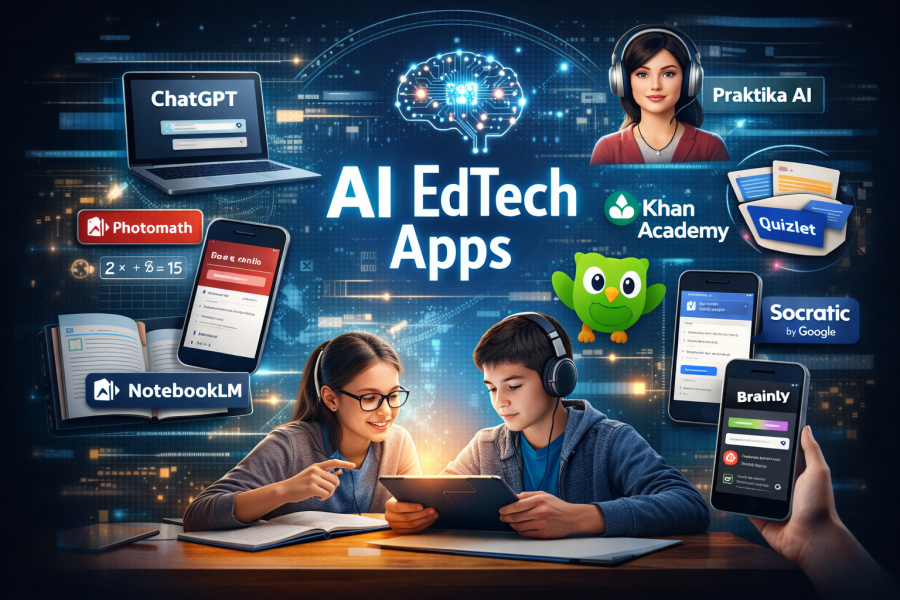
Artificial intelligence has become one of the most influential forces in modern education. AI-powered educational technology applications are reshaping how students learn, how teachers teach, and how knowledge is accessed across the world. These applications use machine learning, natural language processing, and adaptive algorithms to personalize learning experiences, provide instant feedback, and support both learners and educators. Among the many available tools, the following ten AI-driven edtech apps stand out for their impact, usability, and innovation.
ChatGPT is one of the most widely used AI learning assistants globally. It supports students across almost all academic disciplines by explaining concepts, generating study notes, assisting with writing, and answering questions in a conversational format. Students use it for exam preparation, grammar correction, research guidance, and structured learning plans. Its strength lies in its ability to adapt explanations to different learning levels, making complex ideas easier to understand for beginners while still useful for advanced learners.
Photomath has transformed how students approach mathematics learning. By allowing users to scan math problems using a smartphone camera, the app provides step-by-step solutions generated by AI. Rather than just displaying final answers, it breaks down each stage of problem-solving, helping learners understand the logic behind formulas and calculations. This approach supports independent learning and reduces math anxiety, especially among school-level students.
QANDA is another powerful AI-based homework assistant, particularly popular among secondary and higher secondary students. It allows learners to upload images of questions and receive AI-generated explanations almost instantly. The platform focuses heavily on mathematics and science subjects, offering detailed reasoning and alternative solution methods. Its multilingual support makes it accessible to learners from diverse educational backgrounds.
Khan Academy, enhanced with AI tutoring features, offers structured learning content across mathematics, science, economics, computing, and humanities. The AI system helps personalize learning paths by identifying student weaknesses and suggesting targeted practice exercises. It also assists teachers by providing insights into student progress, making it a valuable tool for both classroom and self-paced learning environments.
Quizlet uses artificial intelligence to enhance traditional study methods such as flashcards and quizzes. The app automatically generates study materials from user content and adapts practice sessions based on performance. Students widely use it for exam preparation, vocabulary building, and concept revision. Its AI-driven learning modes help learners focus more on weak areas while reinforcing strong ones.
Praktika AI focuses on language learning through conversation-based practice. Using AI-generated avatars, the app simulates real-life speaking situations and provides feedback on pronunciation, grammar, and fluency. This immersive approach helps learners gain confidence in speaking foreign languages without fear of making mistakes. It is particularly effective for learners who want practical communication skills rather than only textbook knowledge.
NotebookLM is an AI-powered study and research assistant designed to help learners organize and understand large volumes of information. Users can upload documents, notes, or learning materials, and the AI generates summaries, key points, quizzes, and explanations based entirely on the provided content. This makes it especially useful for university students, researchers, and self-directed learners dealing with complex study materials.
Brainly AI combines community-based learning with artificial intelligence. Students ask academic questions and receive AI-supported explanations alongside peer-generated answers. The platform encourages collaborative learning while ensuring clarity through AI-generated step-by-step reasoning. It is widely used for homework help and concept clarification across school and college-level subjects.
Socratic is an AI homework support app that helps students understand academic problems by breaking them down into simpler explanations. By analyzing questions uploaded by learners, it provides visual explanations, concept summaries, and learning resources. The app supports subjects such as mathematics, science, literature, and social studies, making it a versatile learning companion.
Duolingo is one of the most popular language-learning apps enhanced by artificial intelligence. Its AI system adapts lesson difficulty based on user progress and learning patterns. Through gamified exercises, speaking practice, and listening tasks, the app keeps learners engaged while gradually building language proficiency. Its personalized approach ensures consistent improvement and long-term learner motivation.
Together, these AI-powered edtech applications demonstrate how technology is redefining education. They promote personalized learning, improve accessibility, reduce dependency on traditional classrooms, and support lifelong learning. While responsible use is essential to avoid overreliance, these tools, when used effectively, can significantly enhance learning outcomes and educational equity in the digital age.