In this advanced technology era, usually when professionals write content for big companies, they take the help of AI to write faster. But there is a huge problem: AI writing sounds so fake and robotic that people can easily figure it out at just a glance.
In a B2B business setup, when a company sends written work that sounds fake, clients may stop trusting them. There is a high chance it will not be ranking in Google search, and people likely will not even get to see it.
This is the biggest problem for professional writers in their business, because it's not just the stories or blogs; rather, it involves explaining products, educating people, and helping companies with their purchases. Hence, that kind of writing must sound smart, clear, and human, not cold or machine-made.
If people think the content is AI-written, companies can lose their clients, and they will face financial loss and, most importantly, lose the trust as well.
Summary: Top B2B Humanizers at a Glance
Why B2B Content Gets Flagged (And Why It Matters)
Every time content is developed for major brands, writers try to sound as smart and professional as possible. In doing so, they attempt to utilize formal language, proper sentence structure, and industry terminology. That is a major reason why AI produces content in a similar format. The majority of content produced through AI (product comparisons, software descriptions, etc.) appears far too polished.
AI tends to create balanced sentences, use linking words ("moreover," "furthermore"), and have a neutral school textbook tone. While AI-generated writing sounds fine to most people, when checked using an AI detection tool, it screams, “this was written by a machine.”
The fact that you may get caught is not the biggest problem. Google will also verify whether the content shows that the writer has true experience with the subject matter and whether the writer has actually thought about what they are writing about.
If your website contains a lot of boring, generic AI content, Google may push your site down in search results and reduce traffic across your entire website.
Another major concern for businesses is when readers become interested enough to look into whether artificial intelligence (AI) was used to write the content. If readers find out you used AI to create your content, they will lose confidence in your business.
Trust is key to all businesses, but especially for B2B businesses. Bad news travels fast in business; if one of your senior executives states, “I know this was written by AI,” their peer group may also talk about it with each other. The loss of confidence you experience from losing credibility is far more damaging than any advertising or promotional campaign you could develop, and it can be difficult to recover.
How I Tested These Humanizers
I tried testing these tools exactly the same way real business teams use them in daily life. These are the ways I tried to test:
I took 15 business content pieces written by AI, like case studies, expert articles, product descriptions, and email sequences.
I ran all of that content through each humanizer tool.Then I evaluated the tool's results using artificial intelligence (AI) plagiarism detection tools like Originality, Turnitin, and Copyleaks.
To ensure that my rewritten copy would also be factually accurate, understandable, and maintain the same business intent as the original.
To make certain the tone and writing style were consistent across various business models such as SaaS, manufacturing, financial services, and healthcare technology.
Tested personally if the tools performed well on many common business platforms including WordPress, HubSpot, and Contentful.
Finally, I read real feedback from business marketing teams on Reddit, Trustpilot, and G2.
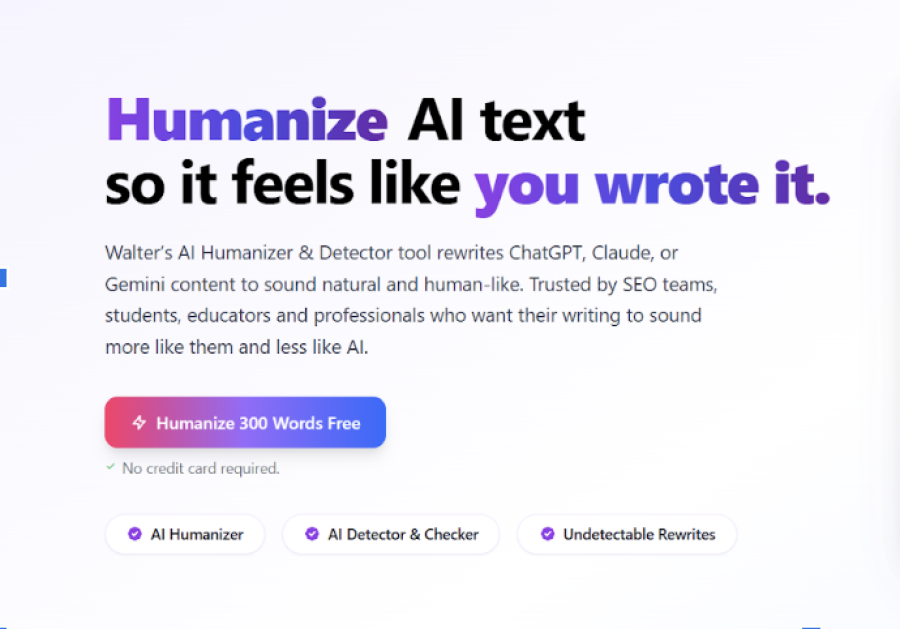
1. Walter Writes AI: Best Overall for B2B Content Marketing
If you are a person who is managing business content and looking for one tool that can handle everything right from emails to long industry reports, this is the best tool to start with.
Walter Writes AI is actually built to fix a common B2B problem: AI content sounds very professional, but it's very dull and lifeless.
This tool looks for clear AI patterns, such as sentences that are all the same length and sentences that have predictable word usage.
It then rewrites that content with more natural variation while keeping technical details and accuracy on point, which is very critical for B2B teams.
I personally tested it on software case studies and white papers. One of the CRM case studies written with GPT-4 scored 98% AI on Originality. After running it using Walter, the score dropped to 7% AI, with all data, metrics, and technical details unchanged.
The main improvement was flow. The original version was structured in paragraphs. The humanized version is mixed with short, direct lines, and it has analytical sections, making it feel more natural.
The best thing about Walter writing is that it supports 80+ languages, which helps teams work with international content. Pricing starts at $12/month (30,000 words), and it may go up to $24/month (70,000 words).
For most of the teams producing 10–15 B2B pieces per month, the middle plan would be enough. There is also another option, a 300-word free trial, to test it on real content.
One of the best advantages is that it has a built-in verification check. Walter actually helps in scanning the humanized content for AI detection before showing results, so you don't have to guess. Based on tests from multiple B2B agencies, it keeps a 95%+ human score across many AI detectors.
2. Quillbot AI Humanizer: Best for Quick Paraphrasing
If you are looking to humanize short business content quickly, QuillBot is the best option. It's very fast and easy to use, and you don't need guidance to use it.
QuillBot actually works best for blog posts, LinkedIn articles, and email sequences. It is very beneficial for leadership content to be between 800 and 1200 words. Its process is very simple. It is very simple; you just need to paste the content and choose how formal you want the result to be, and get the rewritten version in seconds.
QuillBot's strength is rewriting articles with business jargon (industry language) so well that it has been in this business for years.
I used to test QuillBot on a fintech article with technical terms like "tokenization" and "API gateway" which were rewritten intact, but everything else was written naturally.
The main disadvantage is that once you go beyond 2000 words, the flow can break because QuillBot tries to rewrite sentences one by one. You should also be very careful while reviewing content compared to tools made specifically for B2B.
Pricing actually starts from $8.33 per month; hence, the price is very affordable. QuillBot offers both a humanizer and an AI detector on one platform, which is highly helpful for quick checks.
3. Grammarly AI Humanizer: Best for Teams Already Using Grammarly
If you are using Grammarly already, its humanizer fits easily into the existing workflow.
You can write your content using AI and humanize and edit it all in one place. This saves time for multiple B2B teams in approvals and reviews.
I made sure to personally test by comparing products and analyzing competitors' content. It reduces AI detection scores up to 15–20%; it is a decent amount of reduction but not as strong as a dedicated humanizer tool.
Grammarly's biggest strength is its consistency. The tool ensures there will be one voice for your entire site or company, regardless of how many writers you have working on different projects. Additionally, it has B2B options such as professional, confident, and informative.
Humanizer pricing is about $12–$15 per month and includes the humanizer in its premium plans.
However, it would appear there is still a chance for manual editing of heavier humanizations of larger client proposals.
4. Jasper Paraphrasing Tool: Best for Enterprise Marketing Teams
Jasper is really intended to be used by large organizations with many content-related items across several brands or products.
Jasper will work best when your organization has a high volume of content creation (like blog posts, product updates, customer stories), etc., as well as when content is created on a large scale.
I have personally utilized Jasper for a 90-day content strategy for a B2B SaaS company I was working for, and it worked well across multiple content formats.
Jasper’s biggest power is its brand voice control. We can set rules for each of the brands, like tone, important words, and messaging style, depending upon our needs.
When Jasper rewrites the content, Jasper makes sure to follow the rules so that the content sounds the same as our company.
This is highly important for larger B2B teams, where any content they come up with should match their legal, compliance, and leadership expectations.
The best thing about Jasper and other tools is that other tools may pass AI detection but lose the company’s voice. Jasper keeps the company’s voice in its original form.
Jasper normally takes more time to learn and train on your brand first, but once that's done, the results are more consistent.
Pricing usually starts at $49 per month and goes higher depending on teams. The greatest part is that it has a 7-day trial period.
It is highly recommended for large B2B marketing teams who are handling complex content. It saves time by reducing edits and rewrites.
5. Writesonic AI Humanizer: Best for Multi-Channel B2B Campaigns
In B2B marketing, they use many channels. You, being a marketer, will need posts, emails, landing pages, and long content to all work. Writesonic is the best option for all that.
I took a piece of content and tested using the same message across different formats like a LinkedIn article, email sequences, a landing page, and a case study.
Writesonic kept the message the same, but it changed the style for each platform. I saw the LinkedIn content was more casual and short. The case study was formal, but it did not sound robotic.
It also has ready-made templates for B2B campaigns such as product launches, webinars, and lead nurturing. This helps in keeping the whole campaign consistent across all channels.
Pricing starts at $16 per month and goes up to $79, depending on word usage. You get 10,000 free words to test it.
The biggest drawback is that it works best inside Writesonic’s own system; if you are using it only as a basic humanizer, you will miss its advantages.
6. Ahrefs AI Humanizer: Best for SEO-Focused B2B Content
If your business has an abundance of Google Search Traffic, then Ahrefs will be extremely valuable to you.
The great thing about Ahrefs is that it ties together all the SEO Data (Keywords, Rankings & Search Intent) as well as humanizing the Content you are writing.
Humanizing the Content is to see how your Content Changes Affected Keywords, Readability & Overall Search Performance.
I also tested my AI generated B2B Comparison Article with a Competitive Comparison Article; The AI generated version was written like a robot but had the correct keywords for its article.
Ahrefs made it sound more human and improved the keywords because it highly understands what people are actually searching for.
This actually matters for B2B companies, where organic traffic helps in getting leads. You are not just avoiding AI detection; you are typically writing content that works for both real people and Google’s algorithm. Sounds cool, right?
Ahrefs also allows you to stay on track while being in charge of your writing, as it will alert you whenever your content strays from your subject matter.
A major drawback of Ahrefs is the cost. It begins at $129 a month; however, the most wonderful thing about Ahrefs is that it offers all of its full SEO tools, so it is not just limited to the humanizer.
Adding the humanizer to an Ahrefs subscription would make perfect sense if you are currently using the tools for SEO. If you are only interested in a basic humanizer, then it would be too pricey.
7. Surfer SEO Humanizer: Best for Technical B2B Industries
In some of the critical businesses, their content must be 100% correct. Things like product manuals, setup guidelines, and technical white papers cannot afford mistakes. Surfer SEO is very good at handling this kind of content.
I tried testing it on very technical topics like manufacturing software, healthcare tech, and enterprise systems.
It keeps all technical words and details exactly the same. Terms like system names, configurations, and technical processes were not changed. Only the explanations around them were rewritten to sound more natural.
Surfer does this by studying the top-ranking content from the same industry. It understands which part of the content can be rewritten and which part must stay precise. This is highly important for well-regulated or complex industries where wrong wording can damage trust.
This tool works inside the content editor, and it suggests while we write something or edit.
Pricing starts at $89 per month and goes up to $219. The best part is that it has a 7-day money-back guarantee to test it.
If you are looking for only the Humanizer option, then this is going to burn your pocket. But for technical B2B content where accuracy and SEO matter, Surfer is a highly recommended choice.
Red Flags When Choosing a B2B Humanizer
Make sure to look for the warnings, as not all humanizers work equally well for B2B contexts.
Making technical content too casual
Some tools make everything sound friendly and casual; this is bad for serious business content.
Always make sure to test the tool on most of the technical content and check that it still sounds professional.
Losing the main business message
If the important points about your products are weakened, the tool is doing the wrong work. The content must sound human, and it should also help your business grow.
Not trained for business content
Some of the tools are mostly trained on casual or consumer writing. They mostly mess up when it comes to business terms and structured arguments. Always make sure to check if the tool is trained on B2B and technical writing.
No bulk processing
Work will slow down; if you can humanize only one piece of content at a time, mostly for business terms, when creating lots of content, the tool must be able to handle content in bulk.
No proof or testing results
If a tool does not show AI detection scores after humanizing, you will just be guessing. We must be sure that the content is actually passing the AI detectors.
Very limited tone options
Content for business comes in many styles—technical, professional, and conversational. A tool with just one or two tone options won't work for everything.
Before you are ready to pay for a humanizer tool for your business content, make sure to ask these questions.
Does it handle business terms properly?
Make sure that you test it on most technical content. Cross-check if it keeps important words like "API," "go-to-market," or "enterprise architecture" exactly the same.
How many words can you process at one time?
Some of the tools allow only small uploads each time. If you are writing long articles, you need to make sure that you can process them in one go.
Can it work with an API?
API access is more important for large B2B teams; just copy-pasting will not help in scaling for B2B teams with large-scale operations. Access to APIs becomes crucial.
Which detection tools do you test for?
When it comes to B2B, not all of these tools have equal importance. Procurement teams and enterprise clients primarily use Originality.ai, Turnitin, and GPTZero tools, so be specific about them.
Do you offer a refund if the humanized content is still flagged?
Some vendors give guarantees, while other vendors will say they're done with the transaction once you've received the output. Recognize your options when the results are delivered.
Frequently Asked Questions
By how much do typical humanizations reduce AI detection scores?
Typically, a high-quality humanizer will have an average reduction of 70 to 90 percent in detection scores. A detection score that was 95–100% prior to the humanizer will be reduced by 75 to 90 percent; however, this is highly dependent upon several factors, including the quality of the original content, the quality of the humanizer(s) being used, and the detection tool used for scoring.
Will humanization hurt my content's search rankings?
No, if done correctly. While preserving keyword relevance, effective humanizers enhance readability and engagement signals. Poor humanization that introduces grammatical errors or semantic drift poses a risk. Testing and verification are important because of this.
Can I make this content "humanized" when it has been partially edited to some degree by other people?
Yes. A number of B2B teams have found that using AI as an initial draft (for example), followed by a human edit (to ensure that the content is strategically accurate), and finally humanizing (the detectable avoidance of "AI") helps achieve optimal results.
Do I need to use different humanizers for my various content types?
While that is helpful, it isn't necessarily required. A single good-quality humanizer can cover most of your B2B content types as long as it allows for some variation in tone. However, using a special tool for each type may be useful when you are creating both creative thought leadership content and very detailed technical documentation.
How often should I test my humanized content against detectors?
Run any high-stakes content through at least two detectors before publishing it, such as client proposals, significant campaigns, or investor materials. Spot-checking 20–30% of output for regular blog posts and social media content typically identifies any systematic problems.
What if my humanized content still sounds robotic to actual human readers?
Humanizers prioritize avoiding detection over readability. Always conduct a final human review with the goal of determining whether your target audience will find the content natural. You will need more editing or a different tool if it passes detectors but fails the human test.
Can humanizers help with content in languages other than English?
Yes, but the quality varies. Both QuillBot and Walter Writes AI support more than 80 languages. Before committing, test the tool on your target languages, as some have less training data and yield worse results.
Should I tell clients or stakeholders that I'm using AI humanizers?
Your particular relationships and contractual obligations will determine this. Similar to how they use grammar checkers or plagiarism detectors, many B2B content teams employ humanizers as part of their quality control procedure. The fact that you continue to produce original strategic content is the crucial ethical line. All you're doing is utilizing tools to maximize the presentation of that content.