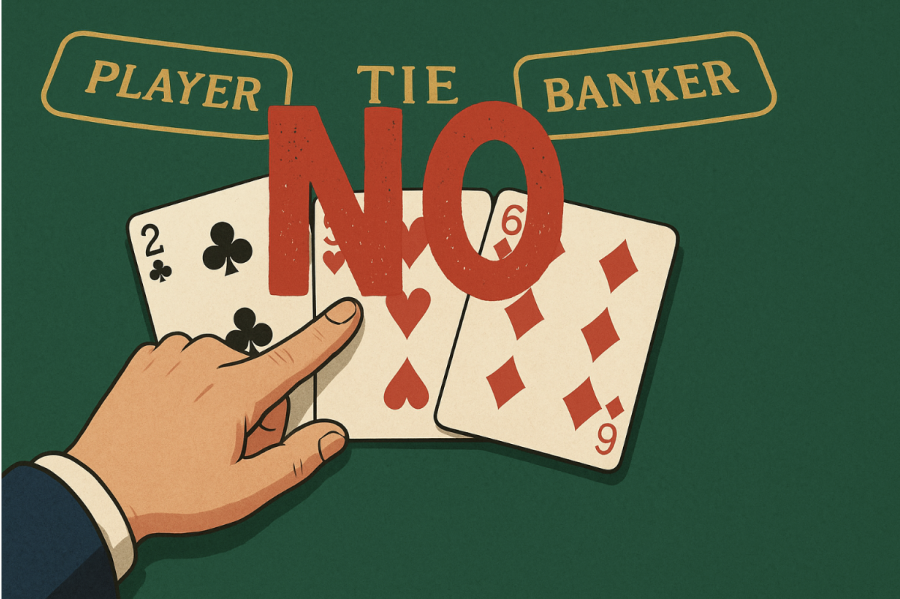
Baccarat (specifically the Punto Banco variation) is a game of fixed, deterministic actions. Once players place their bets, the game's outcome is governed by a strict set of rules that dictate whether the Player hand and the Banker hand draw a third card. These complex drawing rules are the heart of the game’s mathematical structure, giving the Banker a fractional edge.
However, there is a common scenario—the fastest and most decisive outcome in Baccarat—where these complex baccarat third card rules are entirely bypassed. This is the moment of the "Natural," an immediate conclusion to the hand that requires no further action from either side.
Understanding these instant-win scenarios is crucial for both new and experienced players, as they represent a significant portion of all hands dealt. This analysis clarifies when and why the game stops dead in its tracks.
The Definition of a Natural: Eight or Nine
In Baccarat, the goal is for the hand’s total value to be closest to nine. A "Natural" occurs when either the Player hand or the Banker hand—or both—achieves a total of eight or nine points from the initial two cards dealt.
Natural Point Values
Natural 9: Achieved by any combination of two cards that totals 9 (e.g., Ace + 8, or 5 + 4). This is the highest possible hand and the strongest Natural.
Natural 8: Achieved by any combination of two cards that totals 8 (e.g., 5 + 3, or Ace + 7). This is the second strongest possible hand.
The moment a Natural is dealt, the hand immediately stops, and the complex baccarat third card rules are completely disregarded for both the Player and the Banker hands.
Scenario Analysis: When the Hand Concludes Instantly
A Natural is the most powerful card combination in Baccarat, immediately overriding all other considerations. There are three primary scenarios where a Natural dictates the immediate conclusion of the round:
Scenario A: The Player Natural Win
> Player Hand Total: 8 or 9.
> Banker Hand Total: 0 through 7.
> Outcome: The Player hand wins immediately. No third card is drawn by either side. Bets on the Player hand are paid 1:1.
Scenario B: The Banker Natural Win
> Banker Hand Total: 8 or 9.
> Player Hand Total: 0 through 7.
> Outcome: The Banker hand wins immediately. No third card is drawn by either side. Bets on the Banker hand are paid 1:1 (minus 5% commission).
Scenario C: The Natural Tie
> Player Hand Total: 8 or 9.
> Banker Hand Total: The other hand also totals the same score (8 or 9).
> Outcome: The hand is a Tie. All bets on Player and Banker are returned (push). Bets on the Tie segment are paid out (typically 8:1). No third card is drawn by either side.
In all three cases, the Natural acts as an instantaneous "stop" command, preventing any further action from the drawing rules.
The Statistical Significance of Naturals
Naturals are frequent enough to significantly influence the game’s pacing and volatility. Understanding their probability helps players grasp why the majority of hands are decided quickly, without the need for detailed knowledge of the drawing rules.
Probability of a Natural Occurring
While the exact probability varies slightly depending on the number of decks used, the chance of at least one Natural (8 or 9) being dealt in any given round is approximately 34%. This means roughly one-third of all Baccarat hands are settled instantly, bypassing the complex drawing rules.
The high frequency of Naturals underscores why Baccarat is one of the fastest casino games; the complex drawing rules only come into effect two-thirds of the time.
The Drawing Rules: The Backup Mechanism
If neither hand achieves a Natural (i.e., both hands total 0, 1, 2, 3, 4, 5, 6, or 7), the standard baccarat third card rules finally come into play. These rules are activated sequentially:
Player Action: If the Player hand totals 0 through 5, the Player must draw a third card. If the total is 6 or 7, the Player must Stand.
Banker Action: The Banker’s decision to draw or stand is then determined, often conditionally, based on the Player’s hand total or the card the Player drew.
The distinction between the two scenarios—Natural vs. Drawing—is absolute. The drawing rules are merely the contingency plan for when the quick, decisive outcome of a Natural does not occur.
Strategic Implications for the Player
The existence and frequency of Naturals have two main implications for the player:
> Focus on Betting, Not Rules: Since Naturals conclude 34% of hands instantly and the dealer controls the rules for the remaining 66%, the player's energy should be entirely focused on making the optimal bet (Player, Banker, or Tie), not on memorising the complex drawing charts.
> Impact on Tie Bets: A Natural Tie (8 vs. 8 or 9 vs. 9) is statistically rare, contributing to the poor mathematical expectation of the Tie bet. The vast majority of tie outcomes are decided by Naturals.
In Baccarat, the simplest outcomes—the Naturals—are often the most profitable, provided you have placed your wager on the correct side.
FAQs
What is a "Natural" in Baccarat?
A "Natural" is a hand that totals 8 or 9 points from the initial two cards dealt. If either the Player or the Banker achieves a Natural, the hand is instantly concluded, and no third cards are drawn, overriding the complex baccarat third card rules.
What happens if both the Player and the Banker have a Natural?
If both hands have a Natural (e.g., 8 vs. 8, 9 vs. 9, or 8 vs. 9), the hand is concluded instantly. If the totals are the same (8 vs. 8 or 9 vs. 9), the result is a Tie, and bets on Player and Banker are returned. If the totals are different (e.g., 9 vs. 8), the hand with the higher total wins.
How often do Naturals occur in Baccarat?
Statistically, a Natural (8 or 9 in either hand) occurs in approximately one-third (34%) of all Baccarat hands. This high frequency is what makes the game very fast-paced.
If the Banker has a Natural 9 and the Player has a 6, what happens?
The Banker wins immediately. The Natural 9 overrides all other rules, including the rule that would allow the Player to draw a third card on a total of 6. The hand is settled instantly, and no third card is drawn.
Does a Natural 9 always beat a Natural 8?
Yes. If both hands have a Natural, the hand with the higher total always wins. A Natural 9 beats a Natural 8. If the totals are the same (e.g., 8 vs. 8), the result is a Tie.