Can an AI Agent Actually Help You Trade Crypto Better?
Ask ten crypto traders what “AI trading” means in 2026 and you may get ten different answers. The category now covers three very different tools:
AI assistant answers questions, explains charts, or summarizes research without touching your account.
Trading bot follows fixed rules such as grid trading, DCA, or simple if-this-then-that logic. It executes, but it does not reason.
AI trading agent can interpret an objective in plain language, gather data, work through multiple steps, and potentially interact with trading infrastructure on your behalf.
That jump from chatbot to agent is bigger than the marketing around “AI trading” often suggests. An assistant that explains RSI divergence is very different from a system that can check your portfolio, review funding rates, and prepare an order.
In 2026, that gap has started to narrow. Exchanges and trading platforms have been rolling out CLI tools, MCP servers, and agent-focused APIs that connect AI models directly to market data and trading infrastructure. Binance, Gemini, Coinbase, Kraken, Coinrule, MEXC, and others have all moved in this direction.
But better connectivity does not mean better market predictions. An agent that can place a trade does not necessarily know where the market is going. Its real value is reducing the friction between having a trading idea and turning that idea into a structured workflow or action.
That can be useful, but only with sensible risk limits, restricted permissions, and human approval over meaningful decisions.
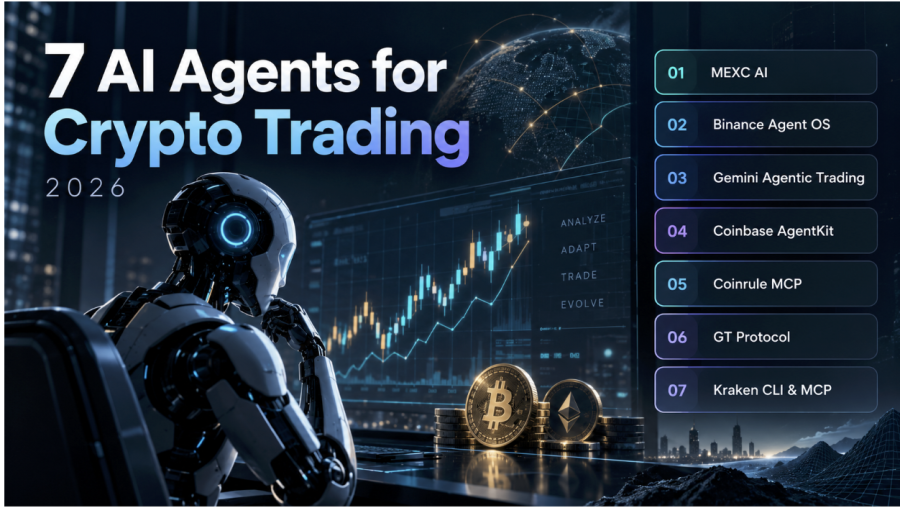
This list compares seven notable options in 2026 across agent integration, data access, workflow flexibility, execution controls, accessibility, and their intended users.
Quick side-by-side view of the seven AI-Agent tools
1. MEXC AI: Overall AI Trading Companion for Agentic Workflows
MEXC AI takes the top spot not because it makes the biggest promises, but because it brings several useful functions together in one AI Trading Companion. It covers the path from discovering market signals to understanding what is happening and preparing an action, while leaving the final decision with the trader.
Rather than acting as a standalone chatbot or an autonomous portfolio manager, it combines market signals, news filtering, chart analysis, market explanations, strategy support, and natural language interaction through an agent-first interface.
It is most useful as the link between having a market idea and turning that idea into something you can properly review.
Discover More: AI Bot and News Radar help traders filter market activity and identify developments worth a closer look.
Understand Faster: Smart Chart and AI market Q&A make it easier to interpret price action and broader market conditions through natural-language questions.
Act Smarter: MEXC CLI provides a natural-language trading interface designed to reduce repetitive steps. Users can check market conditions, balances, or trading rules, then prepare an action for review. Parameters are shown before a write action is executed, and the user must confirm it.
The idea is straightforward: One Request. Fewer Steps. You Stay in Control. The trader still sets the objective, checks the details, and makes the final call.
Ideal for: Experienced and professional traders who want an exchange-native AI Trading Companion that combines research, analysis, and natural-language interaction without giving up decision-making control.
2. Binance Agent OS: Building Exchange-Native Trading Agents
Binance launched Agent OS in August 2026 as a developer platform connecting AI applications with its trading, market data, wallet, payment, and on-chain infrastructure. It combines Binance APIs, Wallet Agentic Hub, x402 payments, a Skill Hub, and an MCP server, allowing tools such as Claude, Codex, ChatGPT, and VS Code to connect through a common interface.
Each agent operates through a dedicated sub-account with configurable and revocable permissions. Binance says its current MCP implementation supports market data, read-only account information, and trading across spot, margin, Convert, and futures. Withdrawal access is not included.
That distinction is important. Binance can see the trades an agent executes, but it cannot see the reasoning inside the AI application behind those trades. This makes permission controls, sub-account isolation, and emergency-stop options especially important as agents become more autonomous.
Designed for: Developers and advanced Binance users building custom trading agents who need detailed control over what those agents can access.
3. Gemini Agentic Trading: Connecting General AI Assistants to Exchange Trading
Gemini introduced Agentic Trading in April 2026, presenting it as an agentic trading tool available through a regulated U.S.-based exchange. Instead of creating another proprietary AI interface, Gemini connected its trading API to MCP. This allows compatible AI models such as Claude and ChatGPT to access exchange functionality through an open standard.
Gemini also provides modular Trading Skills, including real-time market data, bid-ask spread analysis, and historical candle data. These give agents structured tools to work with instead of forcing them to handle generic API responses.
This approach makes sense for traders who already have a preferred AI assistant, prompt library, or existing agent setup. They can connect those tools to Gemini without having to start from scratch with a new exchange-specific system.
The limitation is that exchange access does not automatically make an AI good at managing risk. The model and the instructions it receives still determine how it reasons. Traders therefore need clear strategy rules, exposure limits, and approval requirements before allowing an agent to act.
Recommended for: Traders who already rely on general-purpose AI assistants and want to connect them to exchange trading.
4. Coinbase AgentKit: AI Agent Toolkit for On-Chain Trading Developers
AgentKit is developer infrastructure rather than a ready-made trading agent. It is a framework- and wallet-agnostic toolkit that lets developers add wallets and on-chain actions to AI agents. It also works alongside Coinbase's Agentic Wallets, which are designed specifically for autonomous agents.
The toolkit supports EVM-compatible networks and Solana, with particularly deep integration on Base. Developers can build agents that check wallet balances, execute swaps, interact with DeFi protocols, and combine outside research with on-chain execution through skills such as Authenticate, Fund, Send, Trade, and Earn.
This makes AgentKit more relevant to custom DeFi and on-chain trading systems than to traditional centralized exchange trading.
It is not a plug-and-play trading bot. Building a useful application requires development experience as well as an understanding of wallet security, gas fees, and smart contract risk. The tooling is also experimental, and on-chain transactions can be irreversible.
Geared toward: Developers building custom DeFi or on-chain trading agents who need wallet infrastructure designed for autonomous use.
5. Coinrule MCP: Natural-Language Strategy Automation
Coinrule MCP connects AI assistants such as Claude, ChatGPT, and Grok to a user's Coinrule account through MCP. Once connected, an assistant can inspect balances and positions, review existing strategies, run backtests, and create or manage rule-based automation across crypto, stocks, and ETFs.
Access is controlled through OAuth. Read-only access lets an assistant inspect the account, while Read + Write access allows it to create, launch, or modify strategies.
The main appeal is the way users can start with an idea rather than a configuration form. Instead of manually choosing assets, indicators, entry conditions, exits, and position sizes, a trader can describe a trading thesis in natural language and let the assistant turn it into a rule for testing.
That puts Coinrule somewhere between a traditional rule-based bot and a fully custom AI-agent setup.
There is still plenty of room for mistakes. A backtest does not guarantee future performance, so traders should check the assumptions, market conditions, position sizing, stop rules, and whether the resulting strategy actually reflects the original idea.
Perfect for: Traders who want conversational strategy creation and backtesting without developing their own agent infrastructure.
6. GT Protocol: Multi-Agent Trading Experimentation
GT Protocol focuses on AI agents that build, test, and operate strategies rather than simply producing trade suggestions. Its most visible example is Pentarchy, where five frontier AI models, including Claude, GPT, Gemini, DeepSeek, and Grok, run transparent trading portfolios and publish their positions and reasoning.
Having several models assess the same market setup can be useful because disagreements often reveal assumptions worth looking into. A model that reaches a different conclusion from the others may point to a risk that the rest have overlooked.
Still, agreement between multiple AI systems should not be confused with proof. Different models can rely on the same data, the same assumptions, or the same flawed market narrative. Consensus is still just consensus.
Best suited for: Advanced users interested in multi-model and multi-agent trading experiments, including developers who want to build with GT Protocol's MCP server.
7. Kraken CLI & MCP: Open-Source Agent Interface for Technical Traders
Kraken CLI is an open-source command-line tool covering spot, futures, tokenized stocks, and other products. It includes a built-in MCP server for AI-agent access and is designed around structured, machine-readable output.
A typical workflow is simple. The agent retrieves market data, evaluates it against predefined instructions, proposes an action, and waits for approval before execution. Kraken CLI also includes local paper trading that uses live market data without putting real money at risk, which makes it useful for testing agent workflows before connecting them to a live account.
The main concern is credential security. Once an agent has access to API keys, those permissions become part of the trading risk. A sensible approach is to start with read-only access and paper trading, then add live trading permissions only when there is a clear reason to do so.
Suitable for: Technical traders and developers who want an open, programmable CLI and MCP workflow they can inspect and control themselves.
How to Choose the Right AI Agent for Trading
Start with the level of autonomy you actually need.
Research-focused: Mainly gathers and summarizes information.
Strategy-focused: Creates, tests, or monitors trading rules.
Execution-capable: Can interact directly with exchanges or blockchains.
More autonomy does not automatically mean a better tool. The right choice depends on your experience, strategy, and how much control you are comfortable giving an AI system.
Look at the infrastructure as much as the model. Data quality, supported exchanges and networks, MCP or API access, paper trading, backtesting, approval steps, permission controls, security, risk limits, and activity logs can all matter more than the model name itself.
Most importantly, keep a human involved. AI-generated analysis and strategies should be treated as inputs to a decision, not instructions that automatically become trades. Start with paper trading or limited capital, then expand permissions only after the workflow has been tested properly.
AI Trading Agents Are Becoming Infrastructure, Not Magic Signal Generators
The biggest change in 2026 is not that AI suddenly became a reliable market predictor. The more significant shift is that AI trading is moving away from standalone bots and toward systems connected directly to trading infrastructure through MCP servers, CLI tools, APIs, and on-chain rails.
Binance, Gemini, Coinbase, Coinrule, Kraken, and GT Protocol are all moving in that direction, although each takes a different approach to autonomy and control.
The best AI trading agent is not necessarily the one with the most freedom. It is the one that helps you collect information faster, think through a setup more clearly, and execute within limits you have deliberately chosen.
MEXC AI fits into this broader shift by combining a Discover, Understand, Act workflow with natural-language interaction through MEXC CLI, while keeping validation and the final decision with the trader