Abstract: The credibility of any gambling platform rests on a single assumption: that the outcome of a wager is decided by chance and not by the operator. For more than a century the only available answer to a suspicious player was institutional trust, backed first by regulators and later by independent testing laboratories. The arrival of cryptographic commitment schemes changed the question entirely. Instead of asking players to trust an operator, a class of protocols now allows each individual bet to be checked mathematically, after the fact, by the player who placed it. This paper reviews the cryptographic machinery behind these "provably fair" systems. It describes the role of hash functions, keyed message authentication, and commit-reveal protocols, then reconstructs the standard seed-and-nonce algorithm used across the industry and works through a concrete verification example. The analysis distinguishes between two claims that are frequently conflated: that an outcome was not altered after a bet, and that the underlying odds are fair. We argue that provably fair protocols establish the first with strong cryptographic guarantees while saying nothing about the second. The review closes with the protocol's known limitations, its restricted scope, and the move toward on-chain verifiable randomness as a possible successor.
1. Introduction
Online gambling turned over an estimated hundreds of billions of dollars in annual wagers during the 2020s, yet the industry has never fully escaped a basic credibility problem. A player at a physical roulette table can watch the wheel spin. A player on a website sees only a result delivered by a server they do not control, generated by code they cannot inspect. The recurring questions, whether the games are rigged and whether a result can be trusted, are not paranoia. They are the rational response to an information asymmetry in which one party computes the outcome and the other party simply receives it.
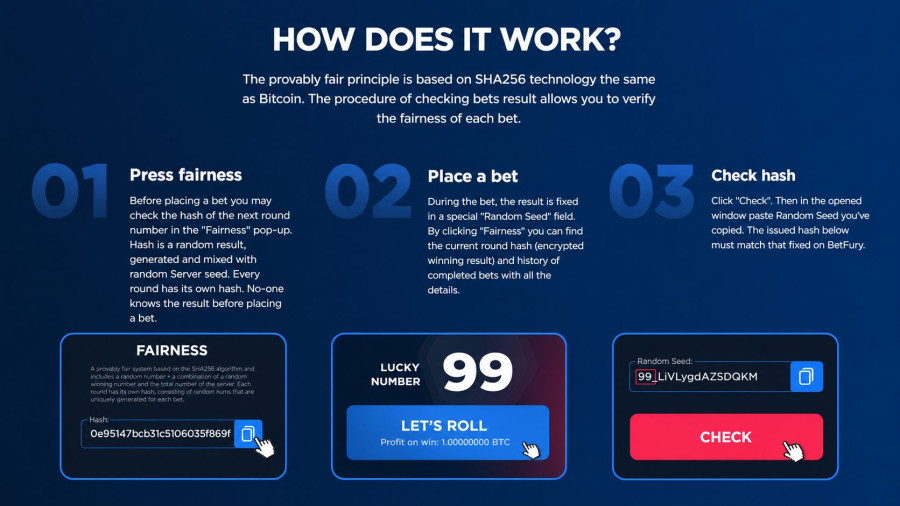
Two answers to this problem have emerged. The older one is institutional. An operator submits its random number generator to an accredited laboratory, receives a certificate, and asks players to trust the certificate. The newer one is cryptographic. The operator commits to a result before the bet is placed, in a form that cannot be read in advance but cannot later be changed, and then publishes enough information for the player to recompute the result independently. The second approach is what the industry calls "provably fair." It is the principle behind BetFury's provably fair system, which publishes a hash of each round before a bet is accepted and lets the player reproduce the result afterward.
The term is used loosely in marketing, where it often means little more than "we use a hash somewhere." This review takes it literally. A system is provably fair, in the strict sense used here, when a player can verify with cryptographic certainty that the outcome of a specific bet was fixed before they committed to it, without needing to trust the operator, a regulator, or any third party. The goal of this paper is to set out exactly what that guarantee covers, how it is constructed from standard primitives, and, equally important, what it does not cover. The analysis is deliberately even-handed. Provably fair protocols are a genuine advance in transparency, but they are routinely oversold, and a careful account of their boundaries is more useful to the field than another uncritical endorsement.
2. Randomness and Trust in Digital Gaming
2.1 Sources of randomness
Every digital game of chance reduces, at some level, to a number drawn from a range. The quality of that draw determines the integrity of the game. Three families of generators are relevant.
True random number generators (TRNGs) derive entropy from physical processes such as thermal noise, atmospheric noise, or the timing jitter of hardware events. They are unpredictable in principle but slow, and their output is difficult to reproduce, which is awkward for a system that later needs to prove what it did.
Pseudorandom number generators (PRNGs) are deterministic algorithms that expand a short seed into a long sequence that passes statistical tests for randomness. The Mersenne Twister, widely deployed since 1998, is the textbook example. PRNGs are fast and reproducible, but a non-cryptographic PRNG is predictable: an observer who recovers the internal state can compute all future outputs. For gambling, that is fatal.
Cryptographically secure pseudorandom number generators (CSPRNGs) add the property that, even given a long run of outputs, an adversary cannot predict the next bit with probability meaningfully better than chance, nor reconstruct earlier outputs. Standards bodies specify constructions of this kind for security use. A provably fair protocol is, in effect, a way of building a per-bet CSPRNG output whose seed is committed in advance.
2.2 The certification model and its limits
Before cryptographic verification became common, the integrity of a generator was established by audit. Laboratories such as eCOGRA and Gaming Laboratories International subject a generator to statistical batteries, including the kind of suite formalised by national standards bodies, to confirm that its output is uniformly distributed and free of detectable patterns. A passing generator earns a certificate, and the operator displays it.
This model works, but it asks the player to trust a chain of intermediaries. The laboratory tested a version of the software at a point in time. The player has no way to confirm that the same code decided their particular spin, nor that the seed feeding it on the night they played was the one the laboratory examined. Certification answers the question "is this generator sound in general?" It cannot answer "was this specific result honest?" Provably fair protocols were designed to close precisely that gap, and a broader survey of the cryptographic foundations of casino fairness shows how encryption, randomness, and verification layer together in modern platforms.
3. Cryptographic Foundations
The provably fair construction rests on three primitives. None is exotic; all are standard tools of applied cryptography, which is part of the appeal. The security of the protocol inherits directly from primitives that have been studied for decades.
3.1 Cryptographic hash functions
A cryptographic hash function maps an input of arbitrary length to a fixed-length output, called a digest. SHA-256, a member of the SHA-2 family standardised by NIST, produces a 256-bit digest, conventionally written as 64 hexadecimal characters. Four properties make it suitable for commitment.
Determinism: the same input always produces the same digest. Without this, verification would be impossible.
Preimage resistance: given a digest, it is computationally infeasible to find any input that produces it. This is what prevents a player from reading the committed result out of the published hash.
Second-preimage and collision resistance: it is infeasible to find a second input matching a given input's digest, or any two inputs sharing a digest. This is what prevents the operator from swapping in a different result that hashes to the same published value.
The avalanche effect: a change of a single bit in the input flips, on average, half the output bits, with no usable correlation between the change and the result. This destroys any shortcut an attacker might hope to exploit.
The size of the output space is what gives these properties teeth. A 256-bit digest has 2^256 possible values, a number on the order of the count of atoms in the observable universe. Searching it by brute force is not a question of better hardware; it is physically out of reach.
3.2 Keyed hashing with HMAC
A plain hash is unkeyed: anyone can compute it. Many provably fair implementations instead use HMAC, a construction that combines a message with a secret key to produce a keyed digest, specified in RFC 2104. In the gaming context the server seed plays the role of the key and the player-supplied data plays the role of the message. HMAC is preferred over naive concatenation of key and message because it is provably resistant to a class of extension attacks that affect simpler schemes, and because its security has a formal reduction to the properties of the underlying hash.
3.3 Commitment schemes
The conceptual heart of the protocol is the commitment scheme, an idea that predates online gambling by decades and traces to work on "coin flipping by telephone," the problem of letting two distrusting parties agree on a fair coin toss over a channel where neither can see the other. A commitment scheme has two phases and two matching properties. In the commit phase a party publishes a binding token for a value it has chosen. The scheme is hiding if the token reveals nothing about the value, and binding if the party cannot later open the token to any value other than the one it committed to. A hash of a secret seed serves as such a token: hiding follows from preimage resistance, binding from collision resistance. The operator commits before the bet; it reveals after; the player checks that the revealed seed both matches the commitment and produces the result they were given. Hiding stops the player cheating, binding stops the operator cheating, and the two together remove the need for mutual trust.
4. The Provably Fair Protocol
4.1 Components
The standard construction uses three inputs.
The server seed is a long random string generated by the operator and kept secret until the reveal. On many platforms it is a 64-character sequence. Its hash is published before play begins and is the operator's binding commitment.
The client seed is a value associated with the player. It may be supplied by the player directly or generated in their browser. Its purpose is to guarantee that the player contributes to the outcome, so that the operator cannot have pre-selected a result that depends only on values it controls.
The nonce is a counter that increments with each successive bet under the same seed pair. It allows one committed server seed to drive many independent bets without reuse, since each nonce value yields a fresh, unrelated output.
4.2 Generating an outcome
The canonical algorithm combines the inputs through a keyed hash. A representative form, used by the largest operators in the sector, is:
digest = HMAC-SHA512( server_seed , client_seed : nonce )
The result is a 128-character hexadecimal string. The protocol then converts that string into a game outcome by reading it in fixed-size chunks, interpreting each chunk as an integer, and mapping the integers into the range the game requires, for example a number from 0 to 9,999 for a four-digit dice result, or a sequence of card positions for a shuffled deck. The conversion procedure is published in full, so that the path from digest to outcome is itself reproducible. Nothing in the chain is hidden except the server seed, and that is revealed at the end.
4.3 Verification and seed rotation
A player who wants to audit their history asks the operator to rotate the server seed. The operator generates and commits to a new seed, then reveals the old one. The player now holds the previously committed hash, the revealed server seed, their own client seed, and the nonce for each bet. Verification is two steps. First, hash the revealed server seed and confirm it equals the value committed before play. This proves the seed was fixed in advance. Second, run the published outcome algorithm on the seed, client seed, and nonce, and confirm it reproduces each result that was paid out. This proves the results followed from the committed seed and nothing else. If both checks pass for every bet, the operator demonstrably could not have altered any outcome after the player committed, because doing so would have required either breaking preimage resistance to fit the published hash or finding a collision, neither of which is feasible.
4.4 A simplified implementation in practice
Implementations vary in how much of this they expose. Some publish the entire seed-and-nonce machinery; others present a streamlined commit-reveal flow. The fairness model documented by BetFury is built on SHA-256 and works on a commit-reveal basis: before a bet, the player can inspect the hash of the upcoming round in the fairness panel, where the winning result has been mixed with a random server seed and locked. The result is fixed at the moment of the bet, and the player can later paste the revealed seed into a checker, recompute the hash, and confirm that it matches the value the platform displayed before the round. The cryptographic claim is the same one analysed above: a result shown as a hash beforehand and reproducible from a revealed seed afterward cannot have been changed in between. The page's own explanation for the choice of SHA-256, that the number of possible outputs makes duplicating a hash infeasible, is a plain-language statement of preimage and collision resistance.
5. From Centralised Commitment to On-Chain Randomness
The protocols described so far still rely on the operator to generate the server seed honestly. The commitment proves the seed was not changed, but a seed drawn from a weak or manipulated entropy source is a separate risk. A line of work addresses this by moving the source of randomness off the operator's server entirely.
Verifiable random functions (VRFs), as deployed in systems such as Chainlink's on-chain randomness service, produce a random output together with a cryptographic proof that the output was generated correctly from a given input by the holder of a specific private key. The proof can be checked by anyone, and the output cannot be predicted or selectively withheld by the producer. Related designs use randomness beacons, public sources that emit unpredictable values at fixed intervals, sometimes aggregated from many independent contributors so that no single party controls the result. Recorded on a public ledger, these values give a game outcome an external, tamper-evident origin that does not depend on trusting the house's seed generation at all. This is the direction in which the strongest fairness guarantees are now moving, although latency, cost, and integration complexity have so far kept fully on-chain randomness confined to a minority of games.
6. Limitations and Critical Analysis
A balanced review has to separate what these systems prove from what they are often claimed to prove. Several limitations are structural, not implementation defects.
Provable integrity is not fair odds. This is the most important and most frequently misunderstood point. A provably fair protocol guarantees that the outcome was not altered after the commitment. It says nothing whatever about the probability distribution of outcomes. A dice game can be perfectly provably fair and still carry a heavy house edge, because the edge lives in the payout structure and the range mapping, not in the integrity of the draw. Verification confirms honesty of process; it does not confirm favourable, or even reasonable, terms. Players sometimes read the cryptographic guarantee as a guarantee of value. It is not.
Scope is restricted to in-house games. The protocol requires the operator to control the full path from seed to outcome. That is feasible for original games such as dice, crash, plinko, and mines, where the operator writes the logic. It does not extend to third-party slot titles or live dealer games streamed from a studio, which rely on the provider's own generator and external certification. On a typical platform the provably fair guarantee therefore covers a specific subset of the catalogue, not the whole of it, a distinction rarely made clear to players.
Entropy quality remains a trust assumption. Commitment binds the operator to a seed but does not prove the seed was sampled from a sound, unbiased source. A server seed produced by a predictable generator could, in principle, be exploited even within an otherwise correct protocol. The client seed mitigates this by injecting input the operator does not control, which is exactly why the player's contribution matters, but the residual reliance on the operator's entropy is real.
Verification is rarely exercised. The mathematics is sound, but the guarantee is only realised if someone checks. In practice the overwhelming majority of players never rotate a seed or run a verification, so the protocol functions for most users as a reputational signal rather than an exercised right. This does not weaken the cryptography, but it does mean that in aggregate the system still operates largely on trust, with verifiability held in reserve.
Implementation is where guarantees are won or lost. The primitives are strong, but a flawed deployment, reusing seeds across players, leaking a server seed before commitment, mishandling the nonce, or using a biased range-mapping step, can undermine the whole construction while still presenting a convincing fairness panel. The cryptographic claim is only as good as the code that realises it, which returns the burden, in part, to the kind of independent review that certification was meant to provide.
7. Discussion
The honest framing of provably fair systems is therefore narrower and more interesting than the marketing version. They do not make gambling fair in any everyday sense, and they do not abolish trust. What they do is relocate trust to a much smaller and more defensible position. Under the certification model the player trusts that an audited generator is sound and that the audited code is the code that ran. Under a provably fair model the player need only trust that SHA-256 behaves as the cryptographic community believes it does, an assumption underpinning a large fraction of the modern internet, and that the operator's entropy source is not actively malicious. Everything between those assumptions and the result on screen becomes checkable. That is a substantial reduction in the surface of required trust, even if it is not its elimination.
The remaining frontier is the entropy assumption, and it is precisely there that on-chain verifiable randomness intervenes, by sourcing the unpredictability from outside the operator and attaching a public proof to it. The trajectory of the field is a steady migration of the trust boundary outward, from "trust the house," to "trust the house's commitment," to "trust a public, externally verifiable source." Each step leaves less to take on faith.
8. Conclusion
Provably fair protocols are a clean application of commitment schemes to a problem that long resisted technical solution: letting a player confirm, without trusting anyone, that the result of a bet was settled before they committed to it. Built from hash functions, keyed message authentication, and the commit-reveal pattern, they deliver a precise and genuinely valuable guarantee. The discipline this review argues for is to state that guarantee accurately. It establishes that an outcome was not tampered with after commitment. It does not establish that the odds are generous, that every game on a platform is covered, or that the operator's randomness is beyond reproach. Read with those boundaries in mind, the protocol is neither a marketing slogan nor a panacea but a meaningful instrument of transparency, and one whose successors, rooted in on-chain verifiable randomness, are likely to push the trust boundary further still.
References
[1] National Institute of Standards and Technology. FIPS PUB 180-4: Secure Hash Standard (SHS). NIST, 2015.
[2] Krawczyk, H., Bellare, M., Canetti, R. RFC 2104: HMAC: Keyed-Hashing for Message Authentication. Internet Engineering Task Force, 1997.
[3] Blum, M. Coin Flipping by Telephone: A Protocol for Solving Impossible Problems. SIGACT News, 1983.
[4] National Institute of Standards and Technology. SP 800-90A Rev. 1: Recommendation for Random Number Generation Using Deterministic Random Bit Generators. NIST, 2015.
[5] National Institute of Standards and Technology. SP 800-22 Rev. 1a: A Statistical Test Suite for Random and Pseudorandom Number Generators for Cryptographic Applications. NIST, 2010.
[6] Matsumoto, M., Nishimura, T. Mersenne Twister: A 623-Dimensionally Equidistributed Uniform Pseudo-Random Number Generator. ACM Transactions on Modeling and Computer Simulation, 1998.
[7] Chainlink Labs. Chainlink VRF: On-Chain Verifiable Randomness. Technical Documentation, 2023.
[8] Gaming Laboratories International. GLI-19: Standards for Interactive Gaming Systems.
[9] eCOGRA. Testing and RNG Evaluation Methodology.
[10] BetFury. Fairness: Provably Fair Verification.
[11] Evonz, L. How Cryptography Ensures Fairness in Online Casinos. Open Applications, 2025.