by Nikki Dobrin, August 31st 2025
It appears that conflicting studies have become a central challenge in managing dry eye diseases. As such, interpreting an increasing volume of evidence becomes a core issue when dealing with a specific patient.
It’s in this area that Dr. Ebenezer Owusu has established himself as a highly regarded contributor, combining clinical insight with rigorous evidence synthesis to support more consistent decision-making in ocular surface disease.
Owusu explains: “When multiple studies reach different conclusions on the same condition, clinicians are left without a clear path forward. My focus has been on bringing that evidence together, evaluating its strength, and translating it into guidance that can actually be used in clinical settings. Without that synthesis, the data alone is not enough.”
Consequently, the significance of systematic reviews in terms of applying the latest evidence-based practices in eye care cannot be underestimated.
Interpreting Conflicting Evidence in Eye Care
Dry eye disease is a condition affecting hundreds of millions of people worldwide. Nonetheless, the diagnostics and management of this health problem vary depending on the region where it is diagnosed.
For clinicians, this issue translates into uncertainties about which treatment approaches should be applied and under what circumstances.
Owusu focuses on facilitating decision-making. In particular, Owusu provides his interpretations based on systematic reviews of different datasets that provide consistent evidence.
In turn, he presents his key point as follows: "It’s crucial to stay on par with the best practices adopted by international experts. Systematic reviews enable analysis of new evidence as a set rather than as individual pieces of data. The process will be more effective when determining which information can actually be regarded as credible and useful for improving patients' well-being."
Having received his Doctor of Optometry (OD) degree from Kwame Nkrumah University of Science and Technology in Ghana between 2013 and 2019—he graduated as Best Male Research Student—Owusu continued to advance in research.
Currently, he is a PhD student in Physiological Optics and Vision Science at the University of Houston, who is writing his dissertation on the "Impact of medicinal maggot excretions/secretions on the ocular surface."
Such experience helps Owusu develop a unique perspective.
As he says himself: "My work covers several disciplines, including laboratory research, optometry, and evidence synthesis. It allows me to see problems from multiple angles. That combination helps me understand both chronic conditions like dry eye and the growing challenge of infectious diseases. It also ensures that the research remains grounded in real clinical needs.”
Owusu adds: “That gives me a uniquely comprehensive perspective – I understand the chronic conditions like dry eye that affect hundreds of millions, and I am also working on the infectious side where antibiotic resistance is becoming a crisis.”
From Local Clinics to International Research Influence
Owusu previously worked as an optometrist at Friends Eye Center in Kumasi, Ghana, from 2020 to 2021. Over his time in Ghana, he contributed to community outreach efforts with multiple clinics and organizations, benefiting more than 10,000 people.
This experience influenced his dedication to accessibility and applicability.
Dry eye and ocular surface infections impact not only the health but also the productivity, education, and quality of life of patients. Especially in developing countries, the problems associated with treatment could be pronounced, as some treatments may be unavailable or hard to perform correctly.
Owusu recalls: "In rural Ghana, patients normally arrive with advanced ocular infections and expect immediate results. You have to explain the disease mechanism with empathy – and when the infection finally resolves, that moment makes everything worthwhile."
Across 11 peer-reviewed papers, he has contributed to topics ranging from tear biomarkers for Parkinson’s disease to corneal nerve changes in multiple sclerosis, as well as dyslipidemia’s relationship with meibomian gland dysfunction.
Several of his 2025 publications explore the antimicrobial and therapeutic potential of Lucilia sericata maggot secretions, including studies in Neotropical Entomology and Wound Repair and Regeneration.
Alongside this, his systematic reviews on dry eye prevalence and treatment strategies have gained traction within the field.
These reviews don’t just aggregate findings; they attempt to resolve discrepancies and provide clarity where clinicians need it most.
Owusu explains the novelty: “This biologically-derived modality is novel for the ocular surface. Unlike conventional treatments that require multiple drops, we are developing a single agent that kills bacteria, modulates inflammatory pathways, and promotes healing. All of this happens while minimizing side effects and addressing antibiotic resistance.”
Recognition, Peer Review, and Scientific Influence
Owusu’s work has drawn recognition from both academic institutions and professional organizations.
Earlier honors also include the 2023 Joe and Janet Barr Early Career Cornea and Contact Lens Research Award and funding from the Minnie and Roseanna Turner Fund for Impaired Vision Research.
He has received multiple awards, including the prestigious 2025 American Academy of Optometry Centennial Ezell Fellowship and the 2024 Bert C. & Lydia M. Corwin Ezell Fellowship. He was also one of the 20 early-career researchers worldwide chosen for the ARVO Science Communication Training Fellowship, an innovative training program that provided him with skills in public advocacy and participation in discussions on Capitol Hill.
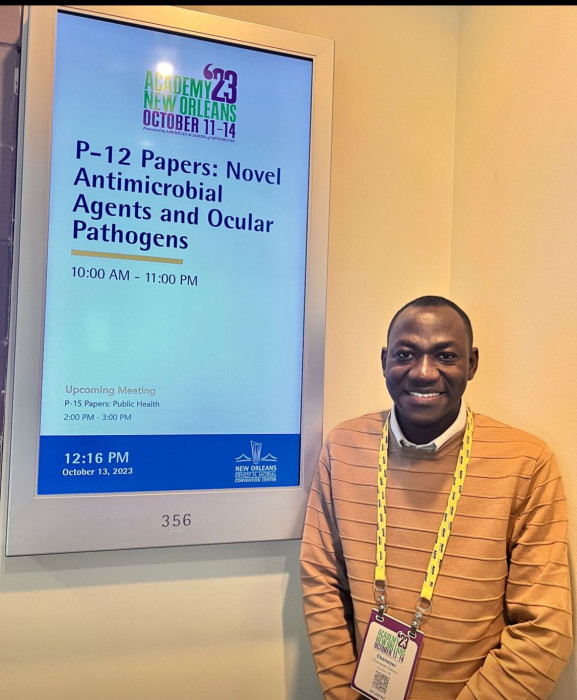
This growing visibility within the Academy was further underscored during the 2025 annual meeting in Boston, where Owusu was invited to moderate a poster session presentation.
Reflecting on the principles that guide this work, Owusu highlights his scientific vision and principles: "I believe scientific integrity regarding reporting results and experimental design is a must-have. Persistence matters because experiments often require repeated refinement. And empathy – drawn from my clinical background – drives everything, because I understand the real suffering caused by these conditions."
Moreover, Owusu actively participates in reviewing colleagues' scientific papers.
In 2025 alone, he reviewed 14 manuscripts submitted to scientific journals, including Contact Lens and Anterior Eye, BMC Ophthalmology, and the Journal of Clinical Medicine.
Professor Mark Willcox, PhD, DSc, Director of Research at the University of New South Wales School of Optometry and Vision Science, Australia, says: "Owusu's demonstration of antibacterial activity in the presence of human tear fluid is significant because tears contain proteases and other immune system factors that can easily inactivate other antimicrobial compounds. His work further shows that maggot secretions suppress bacteria-induced inflammatory signaling in corneal cells, suggesting a dual-action therapy capable of addressing both infection and inflammation.”
Willcox also says: “Owusu is a top performer in our field and precisely the kind of investigator whose work will yield innovations of substantial benefit to the global scientific community. His extensive peer review work reflects strong recognition of his subject-matter expertise by journal editors.”
Exploring Unconventional Therapies in Ocular Science
One of the more unusual aspects of Owusu’s research involves medicinal maggot secretions. Historically used in wound care, these biological agents are now being explored for ocular applications.
The major significance of his work lies in the demonstrated activity of biologically derived maggot secretions in tear fluid.
This suggests that the antimicrobial effect may persist despite the complexity of the environments in which these compounds act. This development will certainly revolutionize how researchers conduct experiments to prevent ocular surface infections.
The study is published in Neotropical Entomology. A commentary by Rattanapitoon et al. in Wound Repair and Regeneration has also highlighted the broader implications of this novel approach.
Owusu frames the importance of this work in his own words: "The concept of using maggot secretions for the ocular surface was considered unconventional, but our published research has now provoked positive commentary in the field. We have shown antibacterial activity even in the presence of human tears, anti-inflammatory effects on corneal cells, and wound-healing potential. That’s significant because no existing therapy offers this combination of actions in a single biological agent.”
Combining antibacterial, anti-inflammatory, and regenerative actions?
In practice, this would mean the clinician would need only one type of medicine to achieve several effects that would otherwise require a cocktail of other medicines.
Shaping Clinical Guidelines and Global Standards
While laboratory research provides one avenue of impact, Owusu’s systematic reviews have influenced clinical frameworks more directly.
The wider impact and influence of Owusu's work is evident in how systematic review articles can affect international guidelines and practices.
His publications on dry eye and meibomian gland dysfunction have been cited in several globally recognized, evidence-based consensus reports from the Tear Film & Ocular Surface Society (TFOS), including: TFOS DEWS III: Management and Therapy; TFOS DEWS III: Digest; TFOS Lifestyle: Impact of lifestyle challenges on the ocular surface; and TFOS Lifestyle: Impact of societal challenges on the ocular surface.
Owusu describes this milestone as follows: "Some of my systematic reviews on dry eye prevalence and meibomian gland dysfunction have been adopted by the Tear Film & Ocular Surface Society. TFOS is a global authority that establishes evidence-based frameworks that clinicians rely on. Seeing our findings directly shape how doctors around the world diagnose and manage dry eye — that is the kind of wider impact that drives me."
For clinicians, such integration translates into clearer guidance. This ultimately supports more consistent patient care.
Simplifying Treatment for Complex Eye Conditions
The current therapy regimen for bacterial infections may involve patients administering various eye drops according to a schedule. Adherence becomes a challenge, particularly in settings with limited health care resources.
Owusu’s contribution lies in making it more manageable when dealing with complicated diseases of the eye. Specifically, his research on a one-drug therapy that treats bacterial infection, inflammation, and wound healing concurrently offers a paradigm shift from the prevailing model of multiple drugs. The benefits include better compliance, lower costs, and easier access, even in developing countries.
In explaining his point of view, Owusu says: “There is no way I can expect a patient with a bacterial corneal ulcer to take four or five different drops on varying schedules throughout the day. This is too confusing, too costly, and causes low compliance. But if I can replace all those drugs with a single drop that kills the bacteria, stops the inflammation, and speeds up the healing process, I am essentially changing the standard of care for this potentially blinding condition.”
Improved adherence, reduced costs, and improved treatment outcomes could be achieved through simplified treatments—especially among underserved communities.
Mentoring, Instruction, and Advocacy in Practice
Outside of formal instruction responsibilities, he has offered informal mentorship to young researchers by supporting them in their scholarly pursuits and the development of research proposals.
Capacity-building activities are a crucial component in enhancing the research environment, especially in locations with limited access to high-quality educational resources.
As a Graduate Teaching Assistant at the University of Houston since 2021, Owusu supports student learning in courses such as Primary Care Optometry Procedures.
Owusu explains: "I enjoy mentoring budding researchers. It's not enough to do good research alone — you have to build the next generation."
In 2025, he participated in ARVO Advocacy Day on Capitol Hill, adding: "Advocacy is part of my responsibility as a researcher. Without sustained investment, even the best ideas never reach patients."
Industry internships in Clinical R&D and microbiology have added an industry perspective to his work.
Owusu highlights: “It is not enough to guide your mentee through the project and its subsequent dissemination. You need to help them learn how to analyze data, synthesize evidence, and present results effectively. This is critical in sustaining progress within the field of evidence-based ophthalmology.”
Expanding the Scope of Ocular Research
Owusu’s publication portfolio includes studies that extend beyond dry eye and ocular surface disease.
The role that tear alpha synuclein plays in the diagnosis of Parkinson’s disease was discussed in a 2024 article. This paper, along with others on meibomian gland dysfunction, was published in the respected journal Optometry and Vision Science.
Again, the theme is synthesizing evidence.
In another paper, his team recruited over 800 participants for a study on the impact of multiple sclerosis on corneal nerve changes.
In both cases, the importance of the study lies in the eye's potential to diagnose other diseases beyond those related to vision.
However, he believes that evidence synthesis plays an important role in all ocular studies, including those on treatment for dry eye.
As Owusu puts it: “No matter whether you are investigating the connection between tear biomarkers and Parkinson’s disease or the changes in corneal nerves due to multiple sclerosis, evidence synthesis is key. Also, the research must be rigorous and the findings must be clinically applicable. That's how ophthalmology advances."
Membership in associations such as the American Academy of Optometry, ARVO, the American Society for Microbiology, and the Ghana Optometric Association demonstrates interdisciplinary involvement, which aligns with his research methodology.
A Human-Centered Approach to Vision Science
At the core of this research is a clear sense of purpose.
Owusu shares his motivation in human terms rather than purely scientific ones: “My driving force is humanity. Eye infection and dry eyes cause significant harm to quality of life, education, and productivity, particularly in resource-poor settings. The emergence of antibiotic resistance makes finding biologically-based solutions essential. I am dedicated to discovering safe and effective treatments that safeguard vision and enhance quality of life."
Dry eye management poses difficulties for many healthcare professionals. Ocular surface illness necessitates more than individual studies or minor advancements. It requires integration of both information and knowledge.
Owusu's contribution to the process comes via his systematic reviews and experimental research.
He muses about his legacy: "When my name is mentioned in the future, I want it to be because of my contribution to vision science. This involves translational research into biologically derived remedies and training the next generation of vision scientists. Ensuring continued innovation and knowledge transfer in ocular surface disease and infectious eye conditions is what drives me. That is how real change happens.”
His efforts demonstrate how robust evidence synthesis can influence practice standards, how novel theories can yield practical solutions, and how attention to practical issues can guide research.
For practitioners navigating a maze of inconsistent literature, such contributions provide clarity. For individuals, they represent the possibility of improved and affordable treatment.