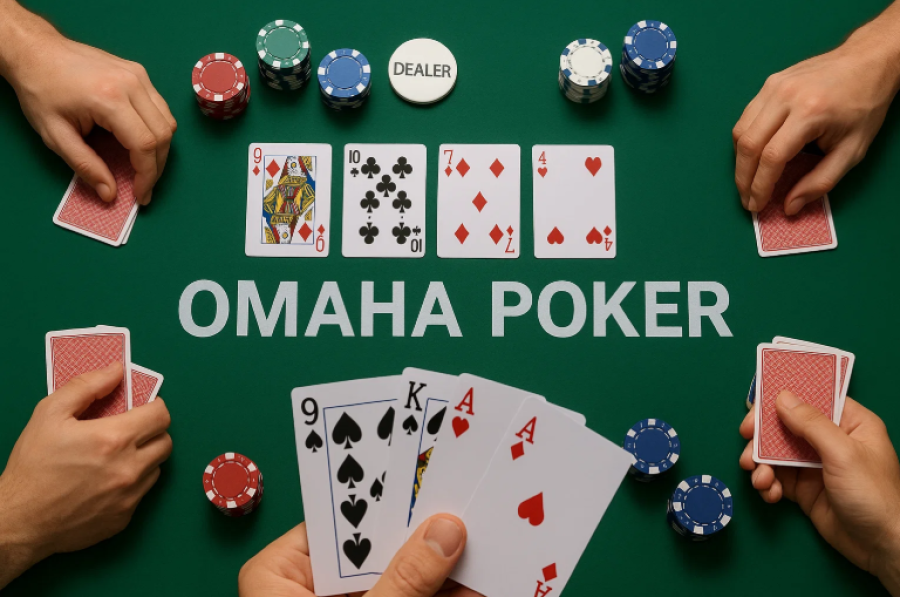
Pot-Limit Omaha has quietly become the second most popular poker format in the world, and in many high-stakes online rooms it has already overtaken Texas Hold'em in traffic. The four-hole-card structure creates richer hand combinations, bigger pots, and far more post-flop complexity than most players anticipate when they first make the switch. That complexity is precisely why a structured Omaha poker strategy matters even more in PLO than in other formats. Luck still plays a role in individual sessions, but over volume, disciplined and informed decision-making is the only reliable path to profit.
If you want to put these strategies into practice straight away, play on BC.Poker — a platform that offers a strong PLO player pool across multiple stake levels, making it one of the better environments to develop your Omaha card game strategy under real competitive conditions.
1. Understand That You Must Use Exactly Two Hole Cards
This is the most common and costly mistake players bring over from Hold'em. In PLO, you are required to use exactly two of your four hole cards and exactly three community cards, with no exceptions. This changes hand reading dramatically. A board of A♠ A♥ A♦ does not give you four-of-a-kind if you hold an ace; you still only use two cards, giving you a full house at best. Misreading your own hand in PLO is surprisingly common and always expensive. Internalising this rule is the very first pillar of any sound basic poker strategy for Omaha.
2. Master Starting Hand Selection
Understanding omaha poker strategy starting hands is where most players either build an edge or develop a costly leak. The best starting hands in PLO are those where all four cards work together: double-suited holdings, connected rundowns, and hands with multiple ways to flop the nuts or strong draws. A hand like J♠ T♠ 9♥ 8♥ has enormous potential, as it can flop straights, straight draws, flush draws, and combination draws simultaneously. By contrast, a hand like A-A-7-2 rainbow, a premium holding in Hold'em, is a trap in Omaha. Favouring coordination over raw card strength is one of the sharpest adjustments players must make when moving into PLO. The following mistakes in this area alone account for a significant share of losses among players new to the format:
Playing uncoordinated four-card hands because they contain aces or kings
Bringing Hold'em hand values into Omaha without adjustment
Chasing non-nut draws and paying off when they get there
Building large pots with marginal made hands on dangerous boards
Over-bluffing into opponents with strong equity
Underestimating the importance of position in post-flop decisions
Avoiding these patterns from the start will save you considerably more than any single strategic adjustment.
3. Nut Draws Are Worth Far More Than in Hold'em
In PLO, the pot-limit structure combined with frequent multi-way pots means equity runs much closer together. A hand with 13 or more outs to the nuts, such as a wrap straight draw plus a flush draw, is often a mathematical favourite or near-coinflip against a made hand. Aggressively playing nut draws is a core element of any winning poker strategy in Omaha. Chasing non-nut draws, however, is where many players leak chips: getting there with a second-best flush or a non-nut straight in PLO is a recipe for losing large pots.
4. Position Is Even More Valuable Than in Hold'em
Positional awareness is a pillar of Omaha strategy at every level, and its value is amplified considerably compared to other formats. Because ranges run closer together and post-flop decisions are more complex, acting last gives you a disproportionate informational edge. In position, you can more accurately size bets to build or control the pot, more confidently bluff when the board texture supports it, and more effectively evaluate whether to continue on turns and rivers. Many experienced PLO players advocate playing a noticeably tighter range out of position, particularly in early streets, as a direct consequence of how much equity position provides.
5. Manage the Pot Size Relative to Your Hand Strength
PLO rewards hands that connect powerfully with the board. Unlike Hold'em, where top pair with a decent kicker can frequently be the best hand at showdown, Omaha is a game of the nuts and near-nuts. One of the most practical Omaha poker daily strategy tips is to think in terms of pot commitment: only build large pots when you hold the nuts or a strong draw to the nuts. Marginal made hands, like bottom two pair or a weak straight, are frequently dominated in multi-way pots. Getting comfortable with pot control on dangerous boards is a key step toward consistent results.
6. Adjust Bluffing Frequency
Bluffing in PLO is structurally more difficult than in Hold'em for a simple reason: your opponents are also holding four cards, which means they connect with boards far more often and are far less likely to fold strong draws or made hands to pressure. Effective poker tactics in PLO lean heavily on semi-bluffs, where you bet aggressively with powerful draws rather than pure air. When you do bluff, board texture matters enormously. Dry, disconnected boards where your line represents a specific strong hand are the clearest spots. Over-bluffing against players who understand their equity is one of the fastest ways to lose a session.
7. Study Equity and Run-Out Scenarios
PLO is a math-intensive game. Because so many hands go to showdown with significant equity on both sides, understanding rough equity percentages in common scenarios, such as set versus wrap or top two versus nut flush draw, gives you a decisive edge. Dedicated equity calculators and regular hand history review are among the most effective tools for accelerating this learning curve. Incorporating structured study into your routine is what separates players who plateau from those who consistently improve their Omaha poker strategy over time.
Applying all seven strategies consistently is, admittedly, a process rather than a switch. To give a clearer sense of where each concept sits in terms of effort and return, the table below maps every strategy by difficulty and effectiveness, a practical guide for deciding what to prioritise first.
The pattern is clear: the highest-impact habits are not the hardest to develop. Position, hand selection, and pot management are all accessible from day one and collectively form the backbone of a reliable Omaha card game strategy.

Omaha Strategy
PLO rewards disciplined players who study and understand the game. Even a basic Omaha strategy focused on hand coordination, position, and pot control outperforms reactive, instinct-driven play. Transitioning from Hold’em to Omaha isn’t just adding two cards; it requires adjusting nearly every strategic instinct. Consistently applying these tips, reviewing hands, and approaching each session with a clear plan separates players who stagnate from those who genuinely improve.